
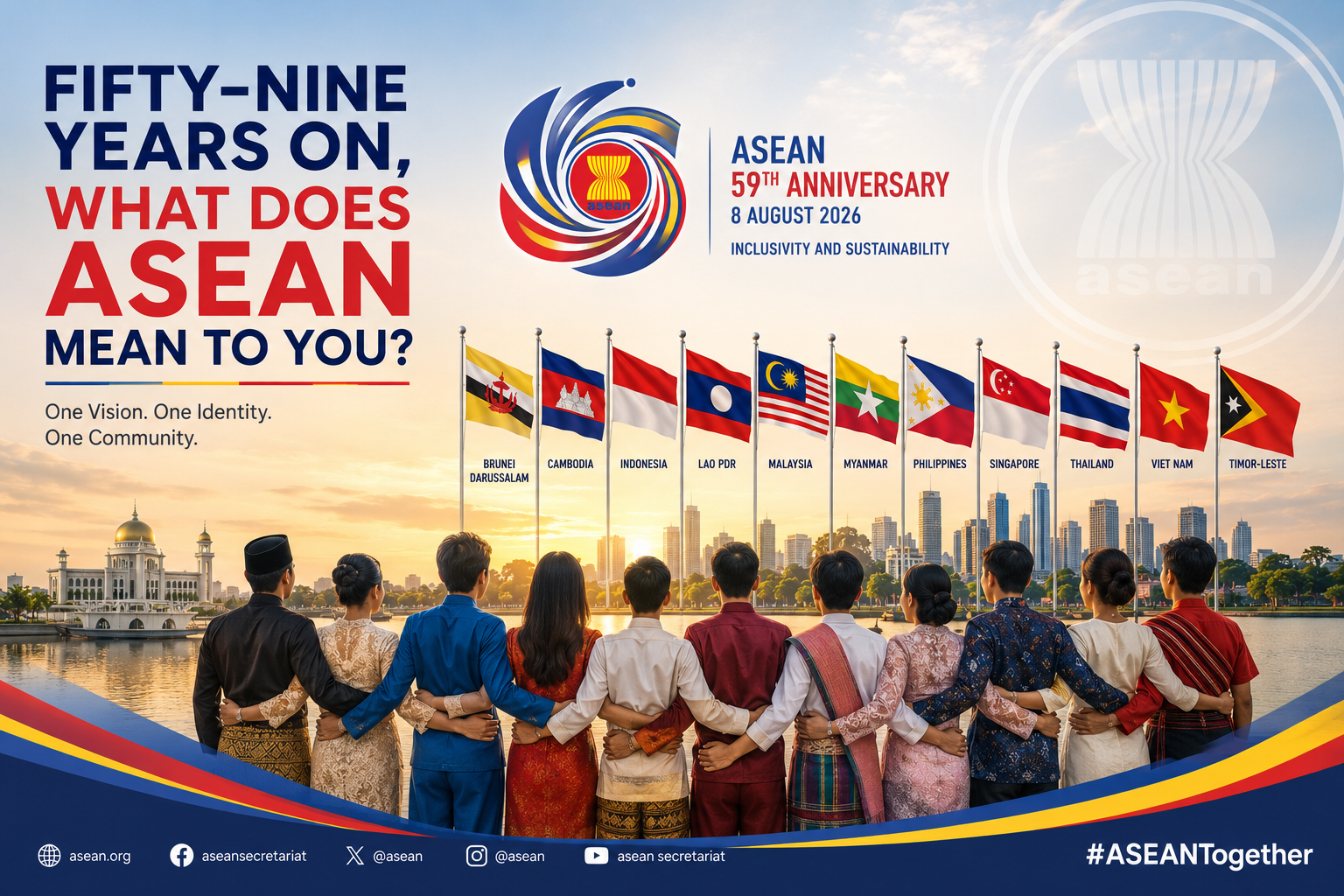
Today marks the fifty-ninth anniversary of ASEAN, and if you’re in Jakarta there will be a proper ceremony for it, the anthem, a video presentation, remarks from the Secretary-General, a message from the Philippines as this year’s Chair. The theme this year is “Navigating Our Future, Together.” It’s also the first ASEAN Day celebrated as an eleven-member bloc, with Timor-Leste having formally joined last October. Somewhere in a conference hall, diplomats in batik, songket and barong will be marking the occasion with the seriousness it’s owed.
Here in Brunei, though, today is just another Saturday. It’s the school holidays, so plenty of families are probably crossing into Miri or down to KL, Bangkok, or Manila for a break, someone’s doing their weekend grocery run at Hua Ho or Supa Save, damissus probably reminding me about something I’ve forgotten. And I think that gap, between the summit stage and the ordinary Saturday, is actually worth sitting with for a moment, because it says something true about what ASEAN has become for a country like ours.
The ASEAN you don’t notice
We don’t really think of it as ASEAN when we book a budget flight to KL for the weekend, or when a cousin heads off to study in Manila or Kuala Lumpur, or when halal certification from here is recognised over there without anyone having to argue about it. It’s not framed as regional integration when it’s just, well, life. But that’s exactly what fifty-nine years of this project has produced. Not a single currency or a shared parliament, nothing that dramatic, but a region that has quietly made it easier to move, trade, study and work across borders that used to matter a great deal more than they do now.
For Brunei, joining in 1984 not long after independence, this was never going to be about being the loudest voice in the room. We’ve always been the smaller state at the table, and honestly, I think that’s suited us. We haven’t needed ASEAN to perform unity for us. We’ve just used it, steadily, for what it’s actually good for. If you want a sense of what that kind of quiet, small-state diplomacy actually looks like from the inside, The Weight of Small Nations traces one imagined career through exactly this territory, Jakarta, Geneva, the region’s back rooms, across three decades.
What it’s actually delivered
I think the honest picture here is a good one. The regional labour movement that lets people build careers outside their home country, the trade relationships that keep goods moving without excessive friction, the education pathways that have sent a generation of Bruneians to study in Kuala Lumpur, Manila, Bangkok and back again, these aren’t abstract policy wins. They show up in real households, including mine. This isn’t a new interest of mine either, back in 2010 I wrote my dissertation on e-government across ASEAN member countries, trying to understand why some governments in the region embraced digital service delivery and others didn’t. Fifteen years on, a lot of that same regional variation is still there, but so is the underlying cooperation that made the comparison possible in the first place.
It’s not perfect, and nobody serious would claim it is. But when I think about what ASEAN was meant to do back in 1967, keep a genuinely diverse region talking to each other instead of at each other, and build enough shared infrastructure that ordinary people could move through it without friction, I think it’s fair to say that project has largely worked. Slowly, unevenly in places, but it has worked.
Navigating together, from a Hua Ho queue
“Navigating Our Future, Together” is the kind of line that sounds like it belongs on a summit banner, and it does. But I don’t think it’s empty. Standing in the queue at Hua Ho, or walking the kids through immigration at the border, or texting a relative working abroad, that’s where “together” actually gets tested. Not in the communique, in whether the systems built on top of that communique quietly make people’s lives a bit easier.
Fifty-nine years in, for Brunei at least, I think they have.