
The unveiling of Brunei Darussalam’s new Cabinet yesterday has understandably attracted significant public attention.
Much of the discussion has centred on the appointment of new ministers, the entry of younger leaders into government, and the elevation of several familiar faces into more prominent roles. Yet beyond the headlines and photographs, what caught my attention was something else entirely.
This does not appear to be merely a Cabinet reshuffle.
It appears to be an organisational redesign.
For years, governments around the world have struggled with a common challenge. The problems they face no longer fit neatly within the boundaries of individual ministries.
Economic diversification is not just an economic issue. It involves education, manpower, investment, infrastructure, technology, trade and even foreign affairs.
Youth unemployment is not just a labour issue. It involves education, industry development, entrepreneurship and social policy.
Digital transformation is not just an IT issue. It requires changes in governance, regulation, culture and service delivery.
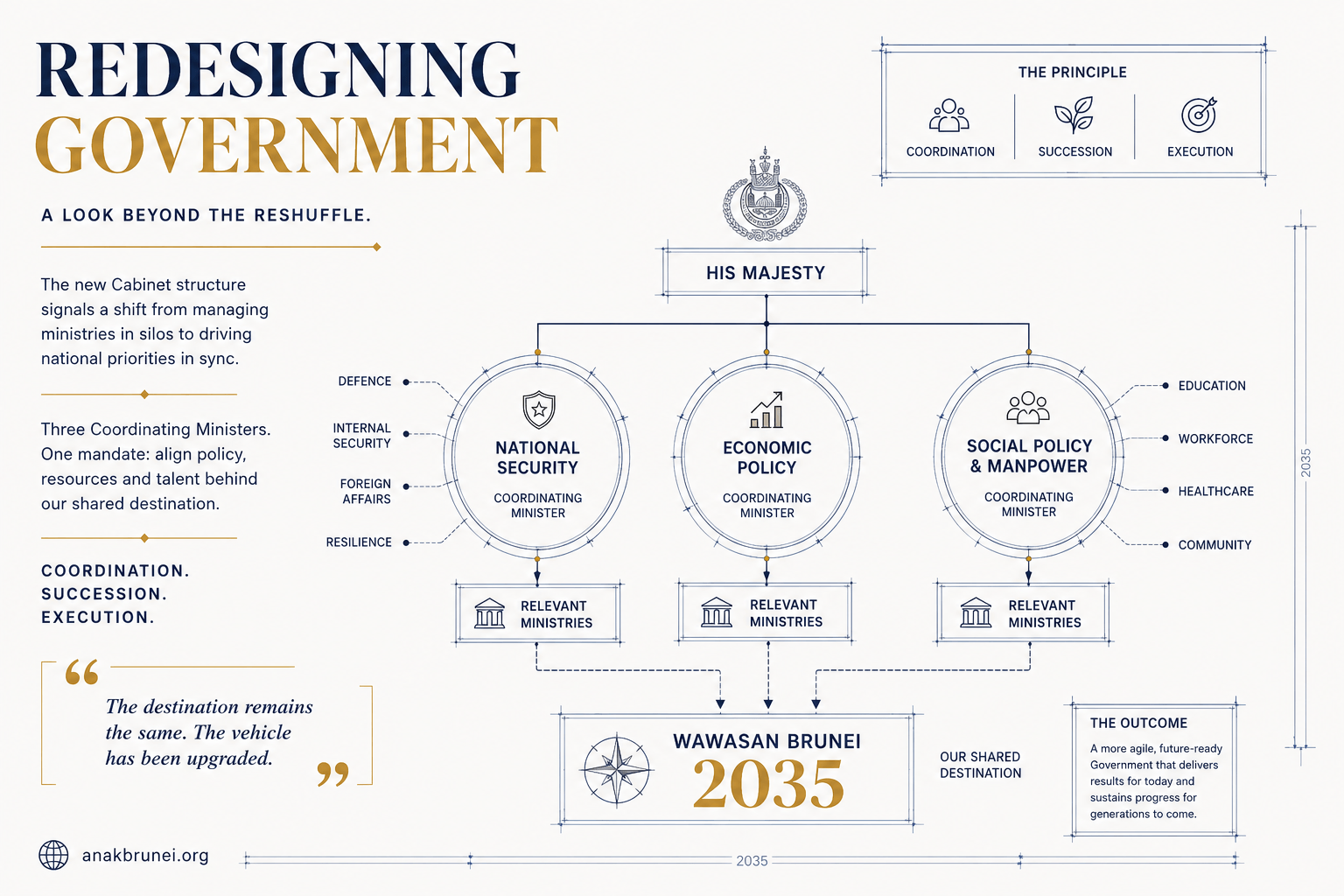
The creation of Coordinating Ministers for National Security, Economic Policies, and Social Policies and Manpower appears to acknowledge this reality.
Interestingly, this is not a uniquely Bruneian approach. Singapore has employed a similar model for many years, appointing Coordinating Ministers to oversee areas such as economic policy, national security, social policy and infrastructure. The reasoning is straightforward: many modern challenges cut across multiple ministries and agencies. Effective solutions therefore require alignment and coordination, not merely good policies.
Viewed through that lens, Brunei’s latest Cabinet structure appears less revolutionary and more evolutionary. It reflects a recognition that governance today is increasingly complex and interconnected.
As someone who has spent much of my career in both government and the corporate sector, I have often observed that organisations rarely fail because they lack strategy. More often, they struggle because different departments pursue their own objectives without sufficient alignment. Sales has one priority. Finance has another. Operations a third. Everyone may be working hard, yet progress remains slow because efforts are not pulling in the same direction.
The challenge facing governments is often similar, albeit on a much larger scale.
The introduction of coordinating portfolios suggests an understanding that national priorities require clear ownership, alignment and execution across multiple stakeholders. In many respects, it is an attempt to ensure that ministries do not merely perform well individually, but work effectively as a system.
Another notable aspect of the new Cabinet is the continued emphasis on succession and leadership development.
Leadership transitions are often discussed only when they occur. The wiser approach is to prepare for them years in advance. By bringing younger leaders into positions of national responsibility today, Brunei is investing in the experience and institutional knowledge that will be needed tomorrow.
This is not unique to government. Every organisation that hopes to remain relevant beyond its current leadership must think similarly. The strongest institutions are those that develop future leaders before they need them.
What has not changed is equally important.
His Majesty’s titah reinforced familiar themes: integrity, teamwork, responsiveness to the rakyat, and the continued pursuit of Wawasan Brunei 2035.

For businesses, this may be the most significant message emerging from the reshuffle. The government’s priorities remain firmly focused on economic diversification, productivity, innovation, human capital development and strengthening the private sector’s role in national development.
For public servants, the expectations are likely to become higher. New structures inevitably bring renewed scrutiny on delivery, accountability and performance.
And for ordinary Bruneians, the questions remain straightforward.
- Will there be more opportunities for our young people?
- Will government services become faster and more responsive?
- Will businesses find it easier to grow?
- Will our economy become more resilient in an increasingly uncertain world?
These are the outcomes by which any Cabinet will ultimately be judged.
A Cabinet lineup, no matter how impressive on paper, is only the starting point.
Success will depend on the ability of ministers, deputy ministers, civil servants, businesses and citizens alike to work towards a common purpose.
Looking at the new structure, I am cautiously optimistic.
The appointments suggest a government that understands the challenges ahead are increasingly interconnected and that coordination may be just as important as leadership.
The foundations have been laid.
Now comes the harder part: turning coordination into outcomes, and strategy into results.
You must be logged in to post a comment.