
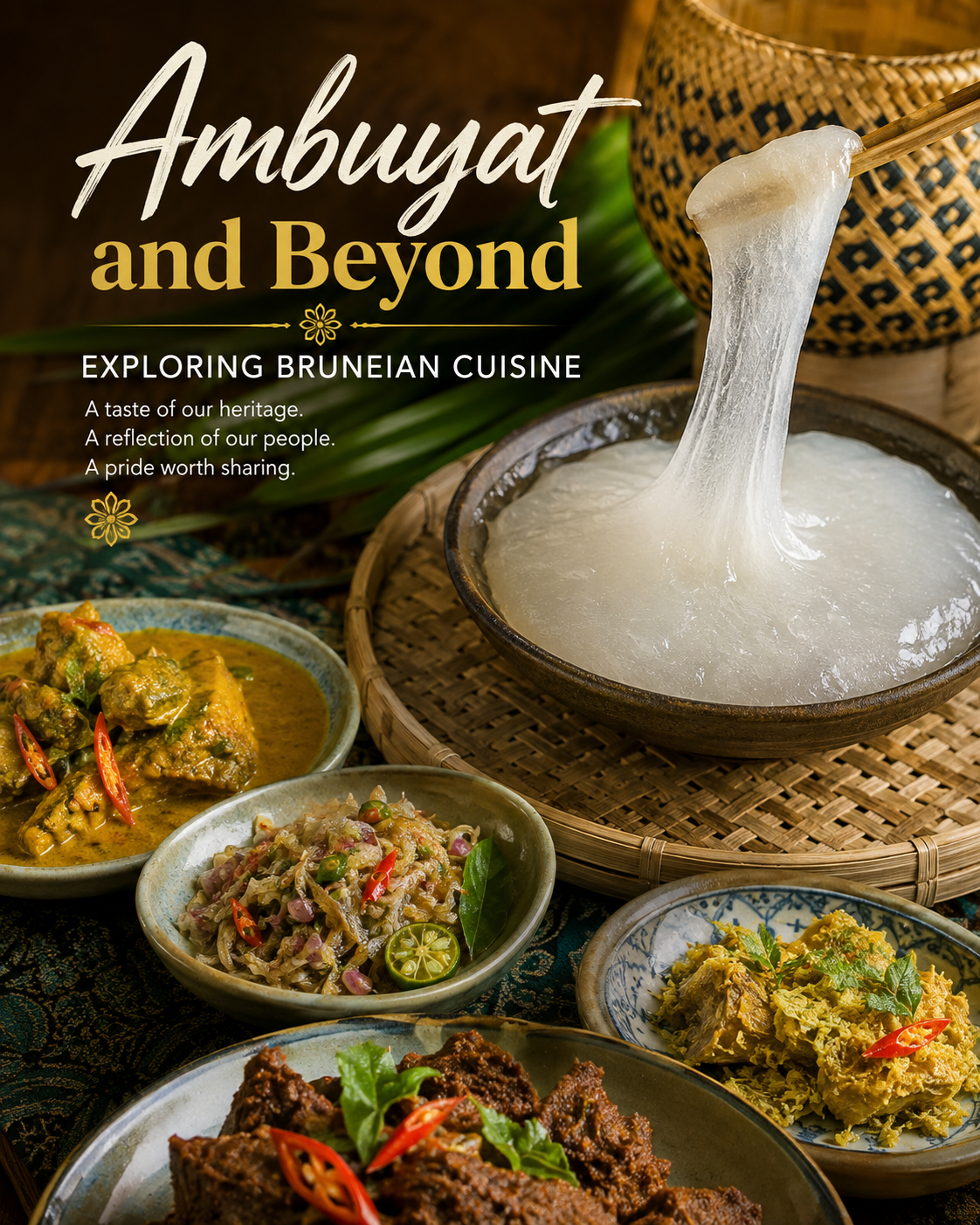
Ambuyat is the dish most people reach for when they want to explain Brunei in one bite. It’s made from the pith of the sago palm, processed into a fine starch and mixed with hot water until it turns into a sticky, translucent paste with almost no flavour of its own. You eat it by twirling it onto a pair of bamboo forks called candas and dipping it into cacah, a sharp, sour sauce usually built on fermented durian (tempoyak) or shrimp paste, tamarind and chilli. The starch carries the sauce. That’s the whole point of it.
It’s also, if you’re not used to it, a genuinely odd thing to eat. Gluey, close to tasteless, eaten with a twisting motion that takes a bit of practice not to make a mess of. But ask most Bruneians and they’ll tell you it’s non-negotiable as a symbol of what this country eats when it eats together.
Ambuyat’s status as national dish isn’t just sentiment. During the Japanese occupation in the Second World War, rice supplies were requisitioned and eventually cut off almost entirely, and Bruneians turned to what the land already gave them: sago pith. It became a matter of survival rather than preference, and it stayed on the table long after the war ended. That history is well documented and worth taking seriously rather than treating as a nice bit of colour.
It’s also worth being precise about who else eats it. Ambuyat isn’t unique to Brunei. The same dish, sometimes under the name linut, is eaten across the Bruneian Malay, Bisaya, Bajau, Kadazan-Dusun and Lundayeh communities of Sabah and Sarawak. Brunei calls it a national dish, and that’s fair, but the sago tradition itself belongs to a wider Bornean food culture that predates the modern border.
This piece is an attempt to map that wider picture: where Bruneian food comes from, what’s actually indigenous to it versus borrowed and adapted, what people eat on an ordinary Tuesday, and where the cuisine seems to be heading next.

Where the Flavours Came From
Brunei sat on trade routes that carried spices, people and cooking habits long before anyone thought to call it a nation’s “cuisine.” Indian traders brought coriander, turmeric and cumin, ingredients that now sit so comfortably in Bruneian cooking that it’s easy to forget they arrived from somewhere else. Chinese migration brought noodle and stir-fry techniques, visible today in dishes like mee goreng and kway teow, adapted with local seasoning and served alongside dishes with no Chinese lineage at all. And the broader Malay world gave Brunei satay and rendang, both of which Brunei has made recognisably its own through small differences in spice blend and technique rather than wholesale reinvention.
None of this erased what was already here. Brunei’s rainforest interior and coastline supply the fruit, herbs and seafood that still anchor the everyday table, and the harder periods in the country’s history, the WWII sago shift chief among them, pushed people back toward what the land could provide directly. The result isn’t a cuisine built from one clean tradition. It’s layered, and the layering is the story.
The Seven Groups, and the Ones Left Out of the Official Count
Brunei recognises seven indigenous groups under the 1961 Nationality Act: Brunei Malay, Kedayan, Tutong, Belait, Dusun, Bisaya and Murut. These are the puak jati, and they’re constitutionally classified together under the broader Malay race. It’s worth naming them accurately, because a lot of writing about Bruneian food (including earlier versions of this piece) treats Iban as one of them. It isn’t. Iban communities do live in Brunei, with a documented and at times difficult history of exclusion from that official seven, but folding them into the puak jati misstates the country’s own classification. If a retrospective on indigenous foodways is going to mean anything, it has to start from the right list.
The Murut, traditionally upland rice farmers, are known for tinonggilan, a fermented rice wine made by mixing rice with yeast and letting it sit for several days until it turns sweet and potent. It shows up at celebrations rather than everyday meals. Murut cooking of wild game, smoked or grilled with local herbs, is a less publicised but equally real part of the tradition.
The Dusun, concentrated in the Tutong and Belait districts, are the group with the strongest documented link to ambuyat itself, given their proximity to sago-producing land. Beyond that, I want to be careful here: several dishes commonly attributed to “Dusun cuisine” in food writing, hinava in particular, are specifically Kadazan-Dusun dishes from Sabah rather than part of Brunei’s own Dusun food tradition. The two Dusun communities are related but distinct, and conflating them is a common mistake worth correcting rather than repeating.
What’s clear is that these communities cook from what the forest and river give them directly, wild game, foraged herbs, river fish, fermented staples, and that this reliance on direct, unprocessed local ingredients is itself the throughline, more than any single dish.
Breakfast, Old and New
The traditional Bruneian breakfast leans hearty. Nasi lemak, coconut rice with fried anchovies, peanuts, egg, cucumber and sambal, is the standard. Roti canai, the Indian-influenced flatbread usually served with dhal or curry, is just as common. Small steamed or fried kuih, made from rice or glutinous rice flour, round out the morning table, particularly during festive periods.
The newer layer is cafe culture: flat whites, avocado toast, granola bowls, often with a local ingredient folded in somewhere. It sits alongside the traditional stuff rather than replacing it, and the street food side, roadside nasi katok stalls, martabak vendors, hasn’t gone anywhere either.
Main Courses
Nasi katok is the dish that best represents how ordinary Bruneian eating actually works: steamed rice, fried chicken, sambal, sold cheap and eaten by everyone regardless of income. Nasi lemak extends past breakfast into lunch and dinner. Seafood, given the coastline, shows up constantly: ikan bakar (grilled fish), sambal udang (prawns in a spicy sauce), sup tulang (bone soup). Meat dishes like black pepper beef and ayam penyet cover the rest.
Daging masak kunyit, beef slow-cooked with turmeric and a blend of aromatic spices until it turns a deep yellow, is another everyday staple worth naming specifically. It’s simpler than rendang, built on turmeric’s colour and warmth rather than a long spice list, and it shows up on home tables more often than restaurant menus.
There’s also a stranger, more specific end of the menu that doesn’t get talked about as much in tourist-facing writing: siput sedut, a type of sea snail, and belutak, made from fattier off-cuts of beef. These aren’t obscure by accident. They reflect a cooking culture that doesn’t waste, and they’re worth including precisely because they’re less photogenic than satay.
Fusion dishes have started showing up too, things like Ambuyat goreng (ambuyat stir-fried rather than served with dips) and pasta dishes built around pais daging. I’d treat these as a real but still small strand of the food scene rather than a dominant trend, more a sign of where a younger generation of cooks is experimenting than evidence the mainstream has shifted.
Ambuyat, In Detail
It’s worth going back to ambuyat once more, because a single paragraph doesn’t do it justice.
The preparation is simple in principle, sago starch mixed with hot water into a sticky paste, but getting the texture right takes practice; too much water and it’s soup, too little and it won’t hold on the candas. What makes the dish is everything around it. The cacah dip, sharp and fermented. The side dishes, often grilled fish or stir-fried vegetables, chosen to contrast with the blandness of the starch itself. And the eating method, communal, hands (or sticks) reaching into shared bowls, which is really the point. Ambuyat isn’t built to be eaten alone.
Its wartime history gives it weight beyond flavour. This was survival food that stayed on the table by choice once the crisis passed, and that’s a more interesting story than “national dish” on its own conveys. It says something that a country’s signature dish is the one born out of scarcity rather than abundance.
Desserts and Sweets
Kuih covers a huge range of small steamed or baked treats: kuih kosui (steamed rice cake with palm sugar and pandan), kuih bingka ubi (baked tapioca cake), kuih mor (a sugar-dusted biscuit tied specifically to Hari Raya). Cendol and ais kacang (also called ABC, air batu campur) are the classic cold desserts, shaved ice built up with coconut milk, palm sugar syrup, and depending on the version, red beans, sweet corn or grass jelly.
Fruit-based snacks, pisang goreng (fried banana fritters) and cucur pisang, are street market staples. Beyond that there’s a growing bakery and dessert cafe scene doing East-meets-West fusion work: Bake Culture, co-founded by actor Wu Chun, and Rumah Gelato are two of the better-known names doing durian cheesecake and local-flavoured gelato respectively, alongside Piccolo Café and Roasted Sip on the specialty coffee and dessert side, and Mr Baker’s Bakeshop and Ximply Chriz for everyday bakes.
Drinks
Air bandung, condensed milk with rose syrup, particularly popular during Ramadan. Teh tarik, pulled tea with condensed milk, sold as much for the pulling technique as the tea itself. Kopi, strong coffee usually taken with condensed milk, sold through both old-school kopitiams and newer specialty cafes. Air tebu, fresh sugarcane juice, common at night markets. And cendol, which straddles the line between drink and dessert depending on who’s serving it.
Festive Food
Hari Raya Aidilfitri is the big one: ketupat (compressed rice in woven palm leaf pouches) paired with rendang, the plain starch balancing the rich, slow-cooked beef. Satay is everywhere during the season too, and kuih mor specifically, made collectively by families in the run-up to the holiday, carries more weight than its size suggests.
Brunei’s other communities bring their own festive food into the picture: Chinese New Year reunion dinners built around dishes chosen for their symbolism (longevity noodles, whole steamed fish), Christmas among the Christian community sometimes blending roast turkey with local spice, Gawai Dayak among Iban communities featuring pansuh and tuak, Deepavali bringing jalebi and gulab jamun into the mix. None of this is Brunei borrowing from outside so much as Brunei being, in practice, more multicultural at the table than the national dish narrative usually accounts for.

The Food Scene: Street to Fine Dining
Pasar Malam Gadong remains the reference point for Brunei’s night market food culture, and nasi katok is the dish that anchors it, sold with enough small variation between vendors (egg or no egg, sambal heat level, extras) that “which nasi katok stall” is its own minor local debate, Nasi Katok Mabohai, Lily and Kaka among the names locals argue over.
Satay has its own circuit of established names, Satay Salim, Satay Hj Ibrahim and SML Satay Makanan Lazat among them. Lee Loi Fatt is a name that comes up often too, though for rojak and cendol rather than grilled meats. Kway teow likewise has several vendors known for particular techniques, Ah Tong Kway Teow, Sungai Liang Kway Teow and the Tasanee stall in Seria among the ones with the strongest followings, high-heat wok work for a smokier result, heavier soy for a darker, sweeter finish. Casual eateries, kedai kopi, remain the backbone of everyday dining, and a specialty coffee and cafe scene has grown up alongside them over the past several years.
At the top end, Brunei’s fine dining scene is small relative to its neighbours but not thin: Pantai Restaurant at the Empire Hotel, Jazz Bar & Grill and Sorriso do an East-meets-West mix of local and Western technique, and Riwaz at the Radisson covers Indian cuisine well.
Contemporary Brunei
Le Keris, run by brothers Qawiem and Qaiyum (originally trained in Empire Hotel kitchens), is a genuine and verifiable example of the kind of Malay-European fusion cooking people mean when they talk about a new generation of Bruneian chefs. Their sous vide chicken curry, chicken cooked sous vide then finished in a traditional curry sauce, is the specific dish that got them attention when they opened in 2017. Worth noting they’re not really “emerging” anymore; the restaurant has been running for close to a decade.
The wellness-food trend is real too: a small cluster of restaurants built around locally sourced, less processed ingredients, sitting alongside the older cafe and kopitiam scene rather than replacing it. And international cuisines, Korean, Japanese, Middle Eastern, have visibly expanded their footprint in Brunei’s dining options over the last several years, part of a broader pattern of a younger, more travelled population wanting more variety without giving up the local staples.
Food delivery apps have changed how a lot of this gets consumed day to day, opening room for delivery-only “cloud kitchen” operations that wouldn’t have made sense as physical restaurants.
None of this displaces the older tradition. It sits next to it. A country that treats a wartime survival food as its national dish isn’t likely to lose its footing just because avocado toast turned up on a cafe menu.
Cooking It Yourself
Bruneian cooking usually starts with tumis, sautéing a ground spice base (garlic, shallot, ginger, chilli) in oil until fragrant, the foundation for dishes like rendang daging and ayam masak merah. Balance matters as much as heat: asam pedas, a tangy fish stew, works because tamarind (sour), chilli (heat), palm sugar (sweet) and belacan (salt and umami) are all pulling in different directions at once.
Here’s one to try at home.
Ayam Masak Merah
Ingredients
- 1kg chicken, cut into pieces
- 3 tbsp cooking oil
- 2 onions, sliced
- 2 cloves garlic, minced
- 1 tbsp ginger, minced
- 3 tbsp chilli paste
- 2 tbsp tomato paste
- 2 tomatoes, cut into wedges
- 1 cup water
- 2 tbsp sugar
- Salt to taste
- 2 kaffir lime leaves
- 1 stalk lemongrass, smashed
Method
Marinate the chicken with salt for at least 15 minutes. Heat the oil and fry the chicken until golden brown, then set aside.
In the same oil, sauté the onions, garlic and ginger until fragrant. Add the chilli paste and tomato paste, and keep cooking until the oil starts to separate from the mixture.
Return the chicken to the pan with the tomatoes. Add the water, sugar, kaffir lime leaves and lemongrass, and stir through.
Lower the heat, cover, and simmer 20 to 30 minutes until the chicken is tender and the sauce has thickened. Adjust salt and sugar to taste. Serve hot with rice.
A couple of notes: frying the chicken first seals in the juices before the long simmer, and it’s worth seasoning at the end rather than the start, since the sauce reduces and concentrates as it cooks. Don’t skip the lemongrass and kaffir lime leaves. They’re doing more work than their small quantity suggests.