
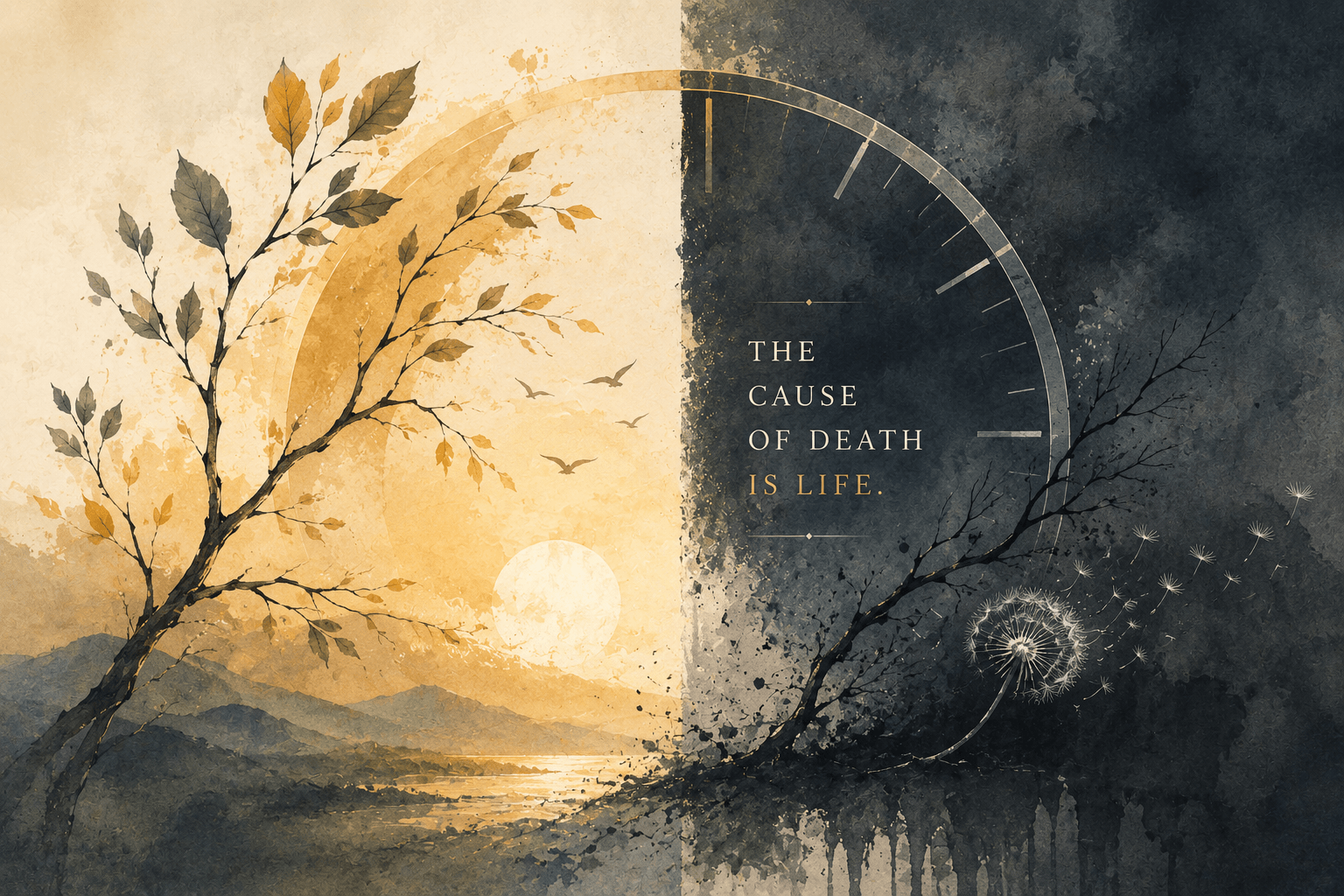
I was watching an interview recently when Karim Khan, the Chief Prosecutor of the International Criminal Court, made a simple yet profound observation:
“The cause of death is life.”
It is one of those statements that stops you in your tracks.
At first glance, it sounds almost absurd. Surely death is caused by disease, old age, accidents, violence, or any number of tragic circumstances. Yet the more I reflected on his words, the more I realised there is a deeper truth hidden within them.
Every death begins with a life.
The moment we are born, we begin a journey that will one day come to an end. Some journeys are measured in decades, others in mere moments. The details differ, but the destination is one we all share.
Perhaps what makes the statement even more striking is that it came from someone who has spent much of his career confronting humanity’s darkest moments.
Yet his observation cuts through all the noise and reminds us of something universal.
Death is not the exception.
It is the rule.
Every living thing is moving towards it.
As we grow older, this reality becomes harder to ignore.
When we are young, death belongs to other people. It is something that happens to grandparents, distant relatives, or names we read about in the newspaper. We make plans years into the future and assume there will always be more time.
Then something changes.
A classmate passes away.
A friend suffers a stroke.
A colleague receives a difficult diagnosis.
Our parents begin to move a little slower.
We attend more funerals than weddings.
Gradually, we realise that death is no longer a distant concept. It is part of our own horizon.
Far from being depressing, I find this awareness strangely liberating.
When we acknowledge that our time is finite, many things lose their hold over us.
Petty arguments seem less important.
Old grudges become heavier to carry.
The need to always have the last word feels increasingly pointless.
We begin to value experiences over possessions, relationships over status, and meaning over mere activity.
The philosopher might stop there and conclude that death gives life its urgency.
Islam, however, takes us one step further.
The Qur’an reminds us:
“Every soul shall taste death.” (Surah Ali ’Imran, 3:185)
Not may taste death.
Not might taste death.
Will.
Death is not an interruption to life. It is part of life’s design.
In another verse, Allah says:
“He who created death and life to test which of you is best in deed.” (Surah Al-Mulk, 67:2)
Notice something remarkable.
The verse mentions death before life.
Both are creations of Allah.
Both serve a purpose.
Both are part of the same journey.
The observation that “the cause of death is life” and the Islamic understanding of mortality are not contradictory. In fact, they complement one another beautifully.
One reminds us that life is temporary.
The other reminds us that life is purposeful.
One teaches urgency.
The other teaches accountability.
One asks us to make the most of our days.
The other asks us to make our days count.
As I edge closer to retirement than to my first day at work, I find myself thinking less about how many years remain and more about how those years are spent.
Am I investing enough time in my family?
Am I serving others in a meaningful way?
Am I leaving behind something useful?
Am I becoming the person Allah intended me to be?
These questions matter far more than the size of a bank account, the title on a business card, or the number of followers on social media.
The cause of death is life.
But perhaps the purpose of life is preparation.
Preparation not merely for retirement, but for the inevitable meeting that awaits every one of us.
And maybe that is why the wisest people I have met are not obsessed with death itself.
They are simply determined to live well before it arrives.