
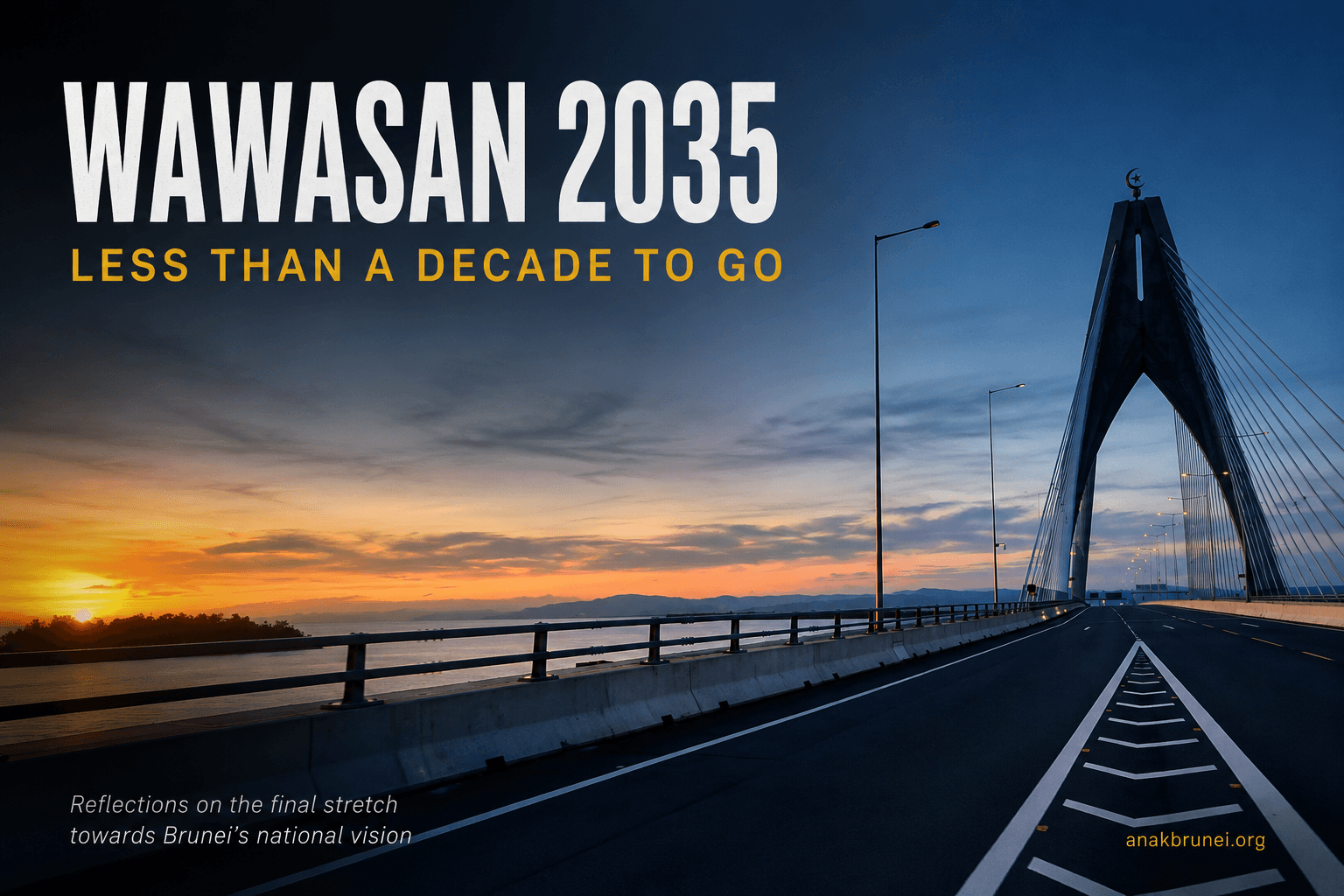
Before sharing these thoughts, it is only fair to acknowledge that I am certain these are matters already under active consideration by His Majesty and His Government. What follows are simply the reflections of a concerned Bruneian who loves this country and hopes, however modestly, to contribute to our shared journey towards Wawasan Brunei 2035.
The recent cabinet reshuffle and appointment of coordinating ministers caught my attention for one simple reason.
Brunei now has less than a decade remaining before 2035.
That may sound like a long time. It isn’t.
In fact, 2035 is now closer to us than 2015.
When Wawasan Brunei 2035 was first introduced, many of us viewed it as a distant aspiration. Thirty years seemed like an eternity. There was time to plan, time to adjust, and time to course-correct.
Today, we are in the final stretch.
Which raises a simple question:
Can we still make it?
This is not a question of doubt or criticism. In fact, it is a question that echoes one raised by His Majesty himself during a meeting of the Majlis Tertinggi Wawasan Brunei 2035 in 2023:
“Namun persoalannya, sejauh manakah usaha telah berhasil sedang tempoh cuma tinggal 12 tahun sahaja lagi.”
It is a fair question.
After all, Wawasan 2035 was never intended to be just another government programme. It is our national vision. A long-term aspiration for Brunei to become a nation recognised for its highly educated and skilled people, a high quality of life, and a dynamic and resilient economy.
Looking around today, there is much we can be proud of.
Our country remains peaceful and stable. We continue to enjoy a standard of living that many countries would envy. Significant investments have been made in infrastructure, healthcare, education and public services. New industries have emerged. Economic diversification efforts have accelerated. Our institutions continue to evolve in response to an increasingly complex and competitive world.
At the same time, it would be difficult to argue that all our work is done.
Education systems around the world are changing rapidly. Technology is reshaping entire industries. Competition for investment, talent and innovation is becoming more intense. The skills required in 2035 may look very different from those required today.
Likewise, building a resilient economy remains a long-term challenge. Diversification is not achieved simply by launching new initiatives or announcing new sectors. It requires sustained execution, investment, talent development and private sector growth over many years.
Fortunately, we do not have to rely solely on impressions.
In 2023, the Government published the first comprehensive Wawasan Brunei 2035 report covering the period from 2015 to 2022, providing perhaps the clearest snapshot yet of where we stand on the journey towards 2035.

What struck me most was not the numbers themselves, but what they suggest.
In some areas, Brunei appears to be within striking distance of its aspirations. In others, the gap remains significant. Yet perhaps the most encouraging takeaway is that progress has been made across all three pillars of Wawasan 2035.
The question therefore may not be whether Wawasan 2035 remains achievable.
The more important question is whether progress can be accelerated sufficiently over the next decade.
And this is where the recent cabinet reshuffle becomes particularly interesting.
The appointment of coordinating ministers may appear, at first glance, to be an administrative change. Yet it may also reflect a recognition that the next phase of national development will require stronger alignment across ministries, agencies and sectors.
Brunei has never lacked plans.
We have blueprints, roadmaps, masterplans and strategies covering virtually every aspect of national development. Many are thoughtful and comprehensive. The challenge has never simply been planning.
The challenge is execution.
Education cannot operate in isolation from economic policy. Manpower planning cannot be separated from industry development. Investment promotion cannot be disconnected from regulatory reform. Technology initiatives cannot succeed without the right talent and infrastructure.
As we move closer to 2035, the ability to coordinate, align priorities and execute effectively may become just as important as the policies themselves.
This is not unique to Brunei. Around the world, governments are discovering that the most difficult challenges are no longer technical in nature. The solutions are often known. The challenge lies in implementation, collaboration and sustained focus.
Perhaps that is why the recent cabinet reshuffle caught my attention.
Not because it changes the destination, but because it may change how we get there.
Wawasan 2035 was never about reaching a particular year on a calendar. It was always about the kind of country we want to leave for the next generation.
With less than a decade remaining, that conversation has never been more important.