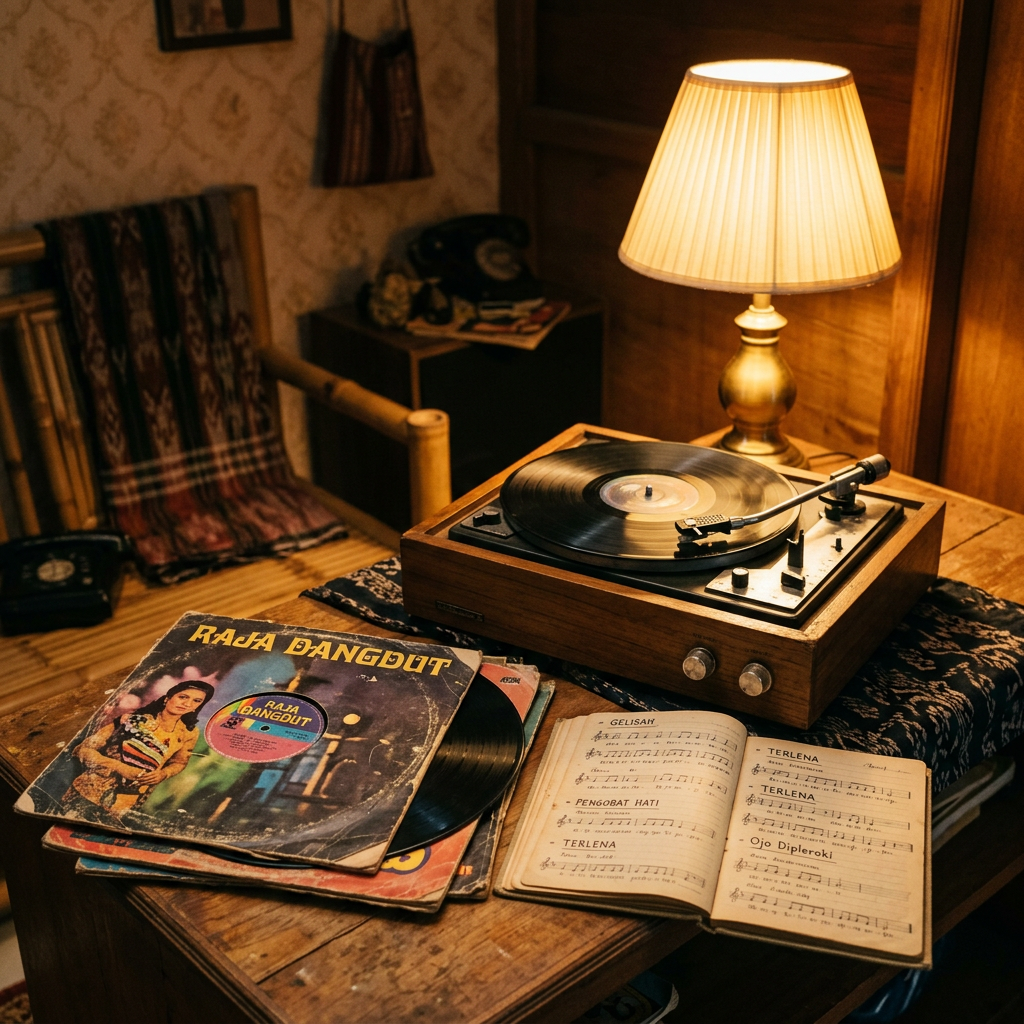
People ask me this more often than I expected. Why Dangdut? A man my age, with my background, humming Rhoma Irama in the car. The truthful answer is that I don’t really know. I can’t even tell you when I first heard it. It feels like it was always somewhere in the background, and at some point I stopped letting it stay there. What I do remember is being mesmerised by the sound itself. The tabla, rolling and teasing the beat. The flute, weaving in and out like it had somewhere better to be. And the singer, doing things with a single note that I still can’t quite explain, stretching it, bending it, climbing and falling back down before you’ve caught your breath. I was hooked long before I thought about why.
But if I sit with the question a little longer, I think the answer is in the words.
Dangdut is often described as the music of the ordinary Indonesian, the sound of the warung, the bus terminal and the kampung wedding. Strip away the sequins and the stage lights and what you find is storytelling. It sings about people who work hard and still come up short, about pride and greed, about young men who think they are invincible, about what money does to a family. Yes, there are the love songs, plenty of them, some so mournful they should come with a warning. But running underneath all of that is a steady commentary on society and on the state of things at the time.
Take Rhoma Irama’s Perbedaan. On the surface it is a simple song about difference. Some people are rich, some are poor, some sit high and some sit low. Rhoma’s point is that this is not an accident or an injustice to be resented, but part of how life is arranged, so that people need one another and the wheel keeps turning. If everyone were wealthy, who would do the work? If everyone were a boss, who would be led? And then he lands the real message: wealth and rank are not the measure of a person. Only faith and piety count before God.
I find that quietly remarkable. It is a sermon, a sociology lecture and a dance number at the same time. You can tap your foot to it at a kenduri and still walk away with something to chew on. How many songs on the radio today manage that?
Then there is Pasrah, the Leo Waldy song that Muchsin Alatas made his own. This one is not about society at all. It is about a man who has given up fighting, who accepts being loved second, and who says he would rather die by a blade than by love. It is melodramatic in the way only dangdut can be, and I love it for exactly that reason. It tells a story in four minutes that a novel might take three hundred pages to tell. There is a lesson hiding in it too, about what happens when we let our hearts overrule our heads, though the song is far too wounded to preach.
That is the thing I keep coming back to. Dangdut tells stories. Cautionary tales, mostly. Don’t stay up all night. Don’t let young blood make your decisions. Don’t measure a man by his car. Don’t give your heart to someone who already belongs to another. It is the voice of the older uncle at the kopi table, the one who has seen a few things and wants to save you the trouble, except he has a band behind him.
Maybe that is why it resonates with me. We are a small society here, and we like our lessons delivered gently, wrapped in something warm. Nobody enjoys being lectured, but everyone enjoys a good song. Dangdut understood that decades ago.
So that is my answer, for whoever asks next. I came to Dangdut for the tabla, for the flute, for those vocal acrobatics that make you stop what you’re doing. But I stay for the stories. They are the same stories we have always told each other, about who we are, what we value and what we should be careful of. They just happen to have a beat you can dance to.