Whatever happened to the ten icons
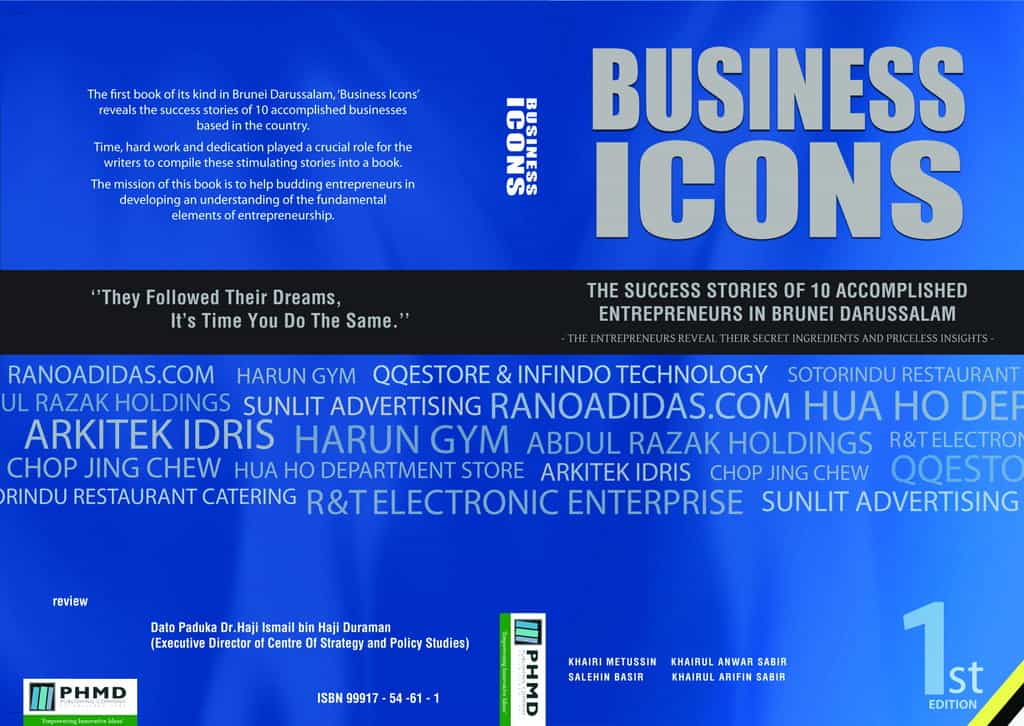
Back in 2011, I wrote about a post called Business Icons: The Success Stories Behind 10 of Brunei Darussalam’s Most Accomplished Individuals, and never really got round to introducing the faces in those photos properly, just captions like “JC Big Boss!” and “Da gangsta!” Fifteen years on, I went back and dug into who these ten people actually were, where they came from, and in some cases what happened to their businesses since. Here they are, in the order the book listed them.
Pehin Hapidz and the Abdul Razak Holdings story

Before he was a businessman, Pehin Hapidz had already lived a full political life. He served as vice president of the Partai Rakyat Brunei during the 1962 revolt and later led another party as its president. By the mid 1960s he’d shifted fully into business, taking the reins of Abdul Razak Holdings, which his family had established in 1978. Their first completed project was the Mile One complex in 1979, and the company grew into one of the country’s biggest private property developers, eventually shaping much of Gadong’s growth. He also served as president of the Brunei Malay Chamber of Commerce and Industry for 35 years and later founded Laksamana College of Business, partly so that Bruneian students wouldn’t need to fly to the UK for a proper business degree.
Dato Paduka Idris Abas, the architect from Kampong Ayer

Already covered his early years in the original post, but worth adding that he studied architecture at the University of Newcastle before returning home to work at the Public Works Department, eventually heading its Architects Section. He set up Arkitek Idris in February 1985, and it became the first local architectural firm to earn ISO 9001 certification. His portfolio includes some of Brunei’s most recognisable buildings, and he later represented the country at APEC’s Business Advisory Council. In a quieter chapter years later, he turned his attention to Trandie, a small eco lodge in Temburong, now run by his daughter Zati.
Haji Zainal Haji Safar, from delivery boy to Sotorindu
Haji Zainal grew up in Katimahar, in a bamboo house, the son of a labourer father and a midwife mother. His first job as a teenager was ferrying fruit and vegetables from farms to market, and after finishing school he worked as a driver for a foreign diplomatic mission. Watching construction crews multiply around Sengkurong in the late 1980s gave him the idea to start feeding the workers on site, and he ploughed those profits into a roadside stall called Cakoi Rindu, which grew into Sotorindu. By 2010 it had branched into six outlets. He was also named Brunei’s best farmer three times, in 1997, 2006 and 2010, and years later ploughed over $150,000 of his own money into developing Katimahar Agri Park, now known for its ATV trails as much as its farmland.
Rano Iskandar, before he became Rano360

At the time this post was written, Rano Iskandar was already building Ranoadidas.com into what would become one of Brunei’s most followed social media platforms. He later evolved the brand into Rano360, and has since worn a few different hats, social and commercial blogger, co-founder of Brukiosk Communication, and a fixture at just about every product launch and community event in the country. Worth noting he’s the odd one out on this list, an online personality and marketer among department store owners and restaurateurs, which says something about how Brunei’s idea of a business icon was already shifting even back in 2011.
Awang Harun, the man behind Harun’s Gym

Harun’s Gym has been a fixture of Brunei’s fitness scene for years, known less as a single outlet and more as a small chain that also trains competitive bodybuilders who go on to represent Brunei at regional and international competitions. It’s one of those businesses locals just know by name, even if the founder himself kept a fairly low profile compared to the others on this list.
Pehin Lau Ah Kok, from $10 in his pocket to Hua Ho

Possibly the most remarkable story of the bunch. Lau Ah Kok left Kinmen at seventeen during the Second World War with just $10 to his name. He arrived in Brunei via a relative’s grocery shop in a Berakas rubber plantation, earning $4 a month sweeping floors and counting stock. In 1942 he bought five acres of land in Manggis for $160 and started a small farm and shop, which became the first Hua Ho. The road wasn’t smooth. A health crisis in 1958 pushed him into bankruptcy and forced the store to close temporarily, and his wife Lim Kui Eng kept the family afloat by managing the farm while he recovered. He rebuilt in the 1960s, diversified into poultry and vegetables, and by the time he passed away in 2018 at 98, Hua Ho had grown into Brunei’s largest homegrown retail chain, still running on the same farm to shelf model he pioneered. In 2004 he was honoured with the title Pehin Kapitan China Kornia Diraja for his contributions to the Chinese community and to Brunei more broadly.
Han King Juan and the birth of Roti Kuning

This one’s close to home for a lot of us. Han King Juan left Hainan at seventeen and arrived in Brunei in 1940 with his cousins, first helping run a small coffee shop. When the cousins left after the war, he stayed on and became sole owner of what he renamed Chop Jing Chew in 1946. He became a Brunei citizen in 1964, and a decade later opened a bakery under the King Liang name, which is where the legendary Roti Kuning came from, the yellow bread that’s still sold by the thousands daily. He passed away in 2015 at 94, but the shop remains one of the most iconic kopitiams in the country, still run by his family.
Jackson Ting and the Consumer Fair machine
Jackson Ting runs D’Sunlit, the company behind Brunei’s Consumer Fair, which has been going since 2008 and is now well past its 30th edition. What started as a bi-annual platform for small vendors to get a shopfront has grown into a five day event drawing well over 100,000 visitors, with hundreds of booths and government backing behind it. Beyond the fair itself, Ting has kept D’Sunlit visibly community minded over the years, running blood drives and channelling fair proceeds to causes like the Children’s Cancer Foundation and the National Association of the Blind. Sunlit Advertising, the entity named in the original book, was the seed that eventually grew into this much bigger operation.
Frankie Ngu and the rise of R&T Electronics
R&T Electronics traces back to the early to mid 1980s, when it started life as a small appliance repair outfit. It’s since become one of the largest home appliance retailers in the country, with branches across Kiulap, Gadong and Kilanas. The business has stayed a family affair over the decades, with newer generations like Andy Ngu and Irene Chew now visible in its marketing and leadership. I couldn’t dig up much on Frankie Ngu’s personal story specifically, which tracks with how low profile he’s kept things.
Nicky Wong, the man behind QQeStore
Of all ten icons in the book, Nicky Wong’s story probably has the most twists. He started as a freelance web designer around 2000, then built QQ Station, Brunei’s first mobile content service, before launching QQeStore, one of the country’s earliest e-commerce platforms, often described as Brunei’s answer to Amazon. He later attempted to take his company Infindo Technology public, which fell apart after disputes with investors, something he’s called one of the most painful chapters of his life. He rebuilt from there, becoming a founding figure behind CheezBox and later bringing Gong Cha to Brunei, eventually running one of the country’s largest bubble tea operations. He was named Brunei’s most promising entrepreneur in 2012 and picked up a BIMP EAGA Asia Pacific Entrepreneurship Award in 2014.
Whatever happened to the authors themselves
Worth a mention too, since two of the four young writers behind the book have gone on to interesting things themselves.
Pg Khairi Metussin went on to co-found Mindplus Education Sdn Bhd, an edtech company established in 2014 with offices in Bandar Seri Begawan and Bandung, Indonesia. The company’s mission centres on using technology to make education more impactful, and Khairi was named among Brunei’s 50 most inspiring LinkedIn profiles in 2021 for that work.
Salehin Basir moved into human resources and has built a career there since. He picked up a Master’s in Human Resource Management from the University of Birmingham, spent time at the Brunei Administrative Service, then rose through Darussalam Assets, the government-linked holding company overseeing more than 30 subsidiaries across sectors like telecommunications, healthcare and hospitality, working his way up to Senior Human Capital Development Manager. He’s since moved on to become Chief People Officer at Jerudong Park Medical Centre.