
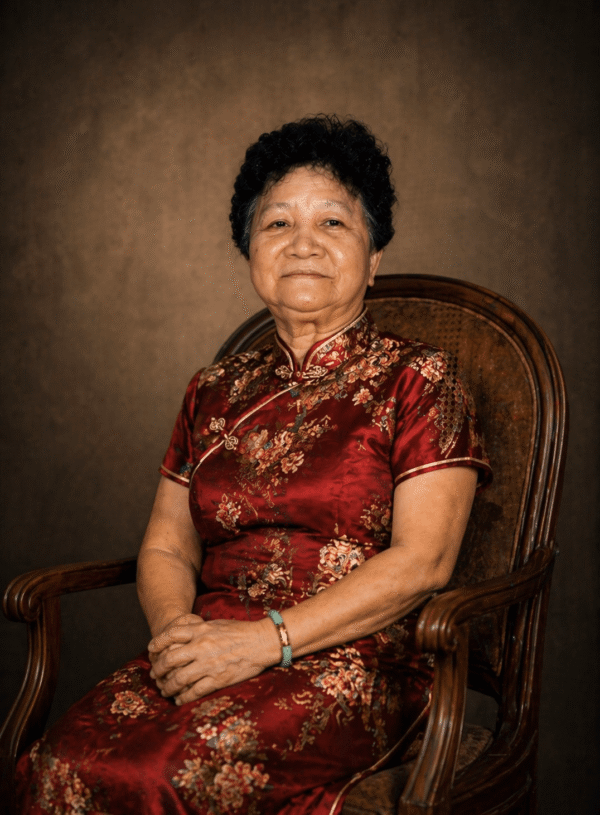
The elderly lady in the featured photo is my beloved maternal grandmother. She lived with us for as long as I can remember. She was Chinese. We were a Malay Muslim household — but my father, to his credit, gave her generous leeway to keep her own customs and traditions. The Chinese things. Her things. He never made her feel like a guest in that regard.
She was simply always there — part of the furniture of my childhood in the best possible sense. When I was older, she moved to live with my uncle, and it was there that she passed away peacefully.
By most measures, she was well looked after. Surrounded by family. Given space to be herself. Never alone in the literal sense.
But I remember the television. The same VHS tapes of Chinese dramas, rewound and rewatched, day after day. Even with the room my father gave her, those tapes felt like her truest refuge — a world she could inhabit fully, without translation.
In her later years, she embraced Christianity. Quietly, in the way she did most things. I think it gave her something the rest of us hadn’t quite managed to: a space that was entirely her own.
I’m older now, and I think about that differently. Presence isn’t the same as connection. Silence isn’t the same as contentment. And being surrounded by people who love you doesn’t automatically mean your inner world is seen.
The weight of unspoken things
Mental health among Brunei’s elderly is one of those topics we acknowledge in theory and avoid in practice. We know it exists. We simply don’t talk about it — and that silence has a cost.
This isn’t unique to any one community. Whether Malay, Chinese, or otherwise, Bruneian families tend to share a common instinct: keep difficulties within the walls. What happens inside stays inside. Seeking outside help — professional help especially — is still read by many as an admission of failure. A family’s failure, not just an individual’s struggle.
For the elderly, this cuts deeper. Their generation was built on endurance. They survived harder things than this, the thinking goes. So the struggle stays hidden. Behind a composed face at family gatherings. Behind reassurances that everything is fine.
What we forget is that silence isn’t the same as coping.
Different communities, same stigma
The specific shape of stigma varies across Brunei’s communities, but the outcome is remarkably similar. In some families, mental distress is attributed to spiritual causes — something to be resolved through faith or traditional remedies rather than professional care. In others, the very vocabulary for inner suffering simply doesn’t exist in the way it needs to. You don’t have a word for something, you don’t talk about it. You don’t talk about it, it doesn’t exist.
Chinese Bruneian families carry their own version of this. Face matters. Maintaining harmony matters. An elderly parent who is visibly struggling becomes, however unfairly, a reflection on the household. So everyone quietly agrees not to look too directly at it.
The result, across communities, is the same: elderly individuals managing quietly alone, long past the point where they should have had support.
What resilience actually looks like
Resilience among the elderly here rarely looks like triumph. It looks like endurance — mostly quiet and unacknowledged. The question worth asking is whether we can make that endurance a little less lonely.
I think of an elderly woman I once heard about — let’s call her Hjh S — who had spent years managing anxiety alone, convinced that speaking up would disrupt her children’s lives. When she finally confided in a close friend, it didn’t unravel her family. It helped her breathe again.
No dramatic intervention. No epiphany. Just one honest conversation that opened a door.
What actually needs to change
The standard advice isn’t wrong: better awareness, more accessible services, training for healthcare workers. All of it is needed. But there’s something more immediate.
Talk to the elderly people in your life. Not just about their health or their grandchildren or what they had for lunch. Ask how they’re really doing. Make space for an answer that isn’t a deflection.
There’s also a language gap worth naming. A significant portion of Brunei’s elderly — whether Malay, Chinese, or from other communities — may struggle to articulate their inner world to a healthcare professional who doesn’t share their language or frame of reference. Good care requires more than clinical competence. It requires understanding what loneliness sounds like in someone else’s mother tongue.
A final thought
My grandmother found her faith late in life, and I think it was her way of reaching for something beyond the daily rhythms of television and quiet meals and the particular loneliness of growing old in a busy household. She didn’t ask for much. Maybe that was the problem — we took her at her word.
There is no shame in acknowledging that the soul can be tired, that grief accumulates, that old age carries its own kind of weight. Our elders carried a great deal for a long time.
The least we can do is actually ask them how they’re doing. And mean it.