Skip to content
Project AB Project AB

Discovering Life's Insights, One Thought at a Time.

Project AB
Project AB

Discovering Life's Insights, One Thought at a Time.

Language Pet Peeves: That means vs That’s mean

Posted on 13/03/202410/07/2026 By Reedz

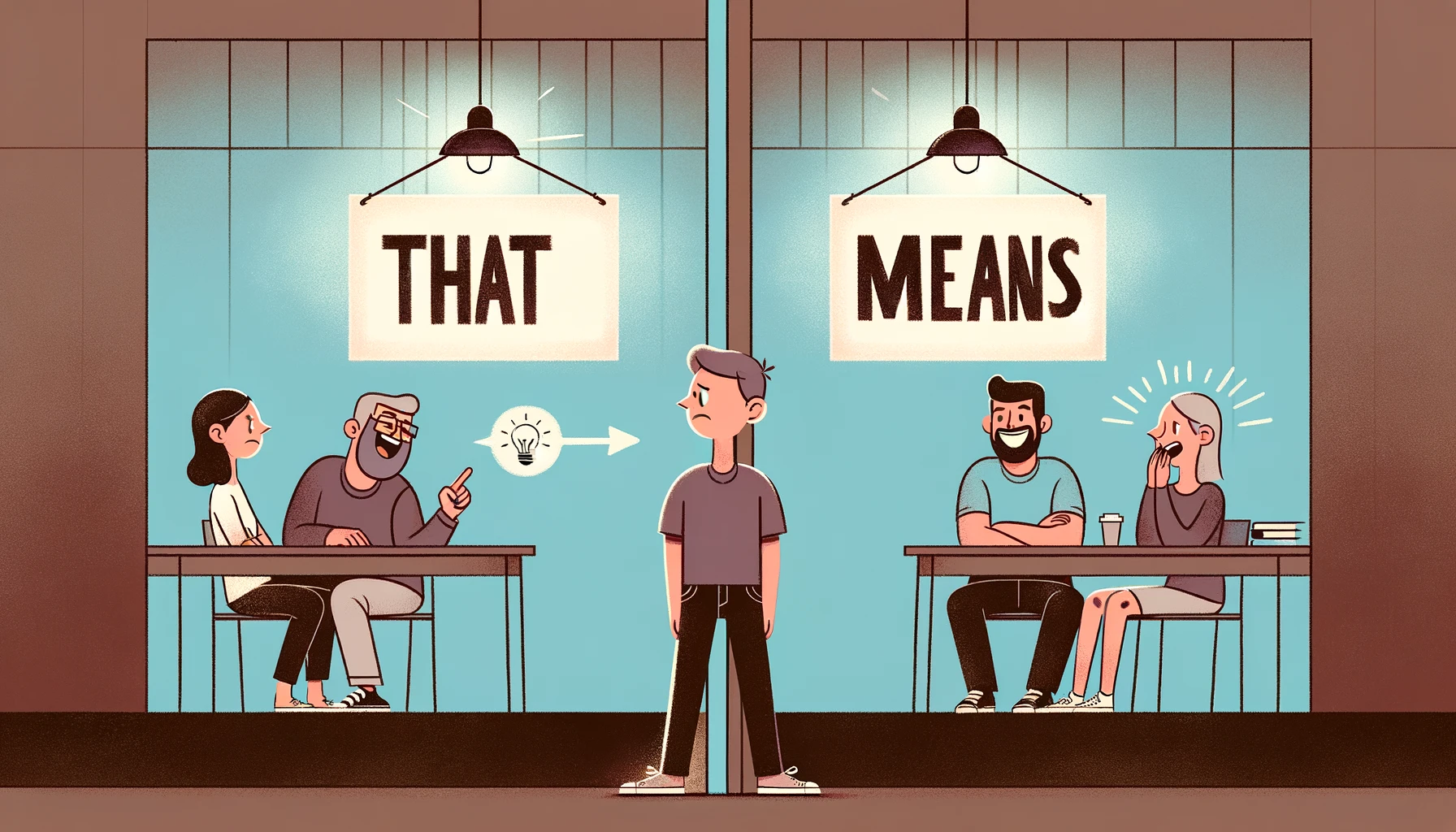
Hey there, language lovers! It’s time for another jaunt through the delightful and sometimes perplexing world of words. Today, we’re untangling a pair that’s notorious for tripping up even the most vigilant among us: “That means” and “That’s mean.” So, let’s dive in and clear up the confusion, shall we?

“That Means” – The Bridge of Understanding

When we say “that means,” we’re on familiar territory. This phrase is a classic connector, a way to explain or clarify something. It’s like a linguistic bridge, helping us cross from confusion to understanding with just a few simple words. Picture yourself in a conversation, unraveling the mysteries of the universe or, more likely, deciphering the instructions for assembling furniture. You hit upon a revelation and declare, “Ah, that means we should’ve used the smaller screws from the beginning!” It’s your lightbulb moment, where everything clicks into place.

“That’s Mean” – The Callout of Unkindness

Switch gears with me to “That’s mean.” Notice the apostrophe s, bringing “that” and “is” together for a different kind of rendezvous. Here, we’re not bridging gaps in understanding; we’re calling out unkindness. “That’s mean” is a judgment call, a way to label an action or word as harsh, unkind, or just plain nasty. Imagine your friend snatches the last piece of pizza and laughs in your face. Your response? “Dude, that’s mean.” It’s a simple phrase, but it packs a punch, conveying disappointment, disapproval, or hurt.

Why the Mix-Up?

So, why do these two get jumbled in the first place? At first glance, they seem distinct enough, right? Well, the confusion often stems from the speed of speech and the slippery nature of contractions. When we’re talking fast, “that’s mean” can sound suspiciously like “that means,” especially to untrained ears. Plus, the English language loves to play tricks on us, with its homophones, homonyms, and other linguistic quirks.

Keeping Them Straight

Here’s a quick tip to keep them straight: If you’re about to explain or clarify something, pause for a second and mentally prepare your bridge – you’re in “that means” territory. If you’re about to express disapproval or call out unkind behavior, remember the apostrophe s. It’s your clue that you’re dealing with “that’s mean.”

In Conclusion

Understanding the difference between “that means” and “that’s mean” can save you from misunderstandings and help you communicate more effectively. Whether you’re building bridges of understanding or calling out unkindness, the right phrase makes all the difference. So, next time you find yourself in a linguistic labyrinth, remember these tips, and you’ll find your way out with ease.

Happy talking, and remember: the power of language is in your hands. Use it wisely, and always strive for clarity, kindness, and understanding. Until next time, keep exploring the vast and vibrant world of words!

Share this:

  • Share on Facebook (Opens in new window) Facebook
  • Share on LinkedIn (Opens in new window) LinkedIn
  • Share on Telegram (Opens in new window) Telegram
  • Share on WhatsApp (Opens in new window) WhatsApp
  • Share on Reddit (Opens in new window) Reddit

Related

Language & Musings EnglishLanguage

Post navigation

Previous post
Next post

Related Posts

Language & Musings

What flavor ADHD are you?

Posted on 31/01/202410/07/2026

ADHD, or Attention-Deficit/Hyperactivity Disorder, is a neurodevelopmental disorder that can present itself in various forms, each with unique challenges and traits. Understanding these types can help individuals, caregivers, and professionals tailor support and interventions appropriately. Here’s an overview of the different ADHD types: Classic ADHD: This type is what most…

Share this:

  • Share on Facebook (Opens in new window) Facebook
  • Share on LinkedIn (Opens in new window) LinkedIn
  • Share on Telegram (Opens in new window) Telegram
  • Share on WhatsApp (Opens in new window) WhatsApp
  • Share on Reddit (Opens in new window) Reddit
Read More

When Helping Becomes Micromanaging

Posted on 24/02/202303/09/2026

Micromanagement often begins with good intentions. Then helping becomes checking, checking becomes correcting and capable people stop deciding.

Share this:

  • Share on Facebook (Opens in new window) Facebook
  • Share on LinkedIn (Opens in new window) LinkedIn
  • Share on Telegram (Opens in new window) Telegram
  • Share on WhatsApp (Opens in new window) WhatsApp
  • Share on Reddit (Opens in new window) Reddit
Read More

Things I’m Still Learning

Posted on 22/02/202303/09/2026

Some lessons are learned once. Others keep returning to check whether I was paying attention.

Share this:

  • Share on Facebook (Opens in new window) Facebook
  • Share on LinkedIn (Opens in new window) LinkedIn
  • Share on Telegram (Opens in new window) Telegram
  • Share on WhatsApp (Opens in new window) WhatsApp
  • Share on Reddit (Opens in new window) Reddit
Read More

Search

  • Home
  • Latest
  • About
  • The Weight of Small Nations
  • Bruneian Chevening Scholars So Far...
  • New Media and Identities
  • Circle of Concern vs Circle of Influence

Top Posts & Pages

  • Home
  • Penyakit Ain: Between Faith and Fear
  • More Than a Cabinet Reshuffle
  • New Friends and Old Friends
  • Dirgahayu Kebawah Duli Tuan Patik: Eighty Years On
  • Fifty-Nine Years On, What Does ASEAN Mean to You?
  • Quick and Dirty Roast Lamb...
  • Circle of Concern vs Circle of Influence
  • The Business Icons of Brunei!
  • Whatever Happened to Brunei's Ten Business Icons?

Archives

Meta

  • Log in
  • Entries feed
  • Comments feed
  • WordPress.org
© 2000-2026 Md Reeda Hj Malik