
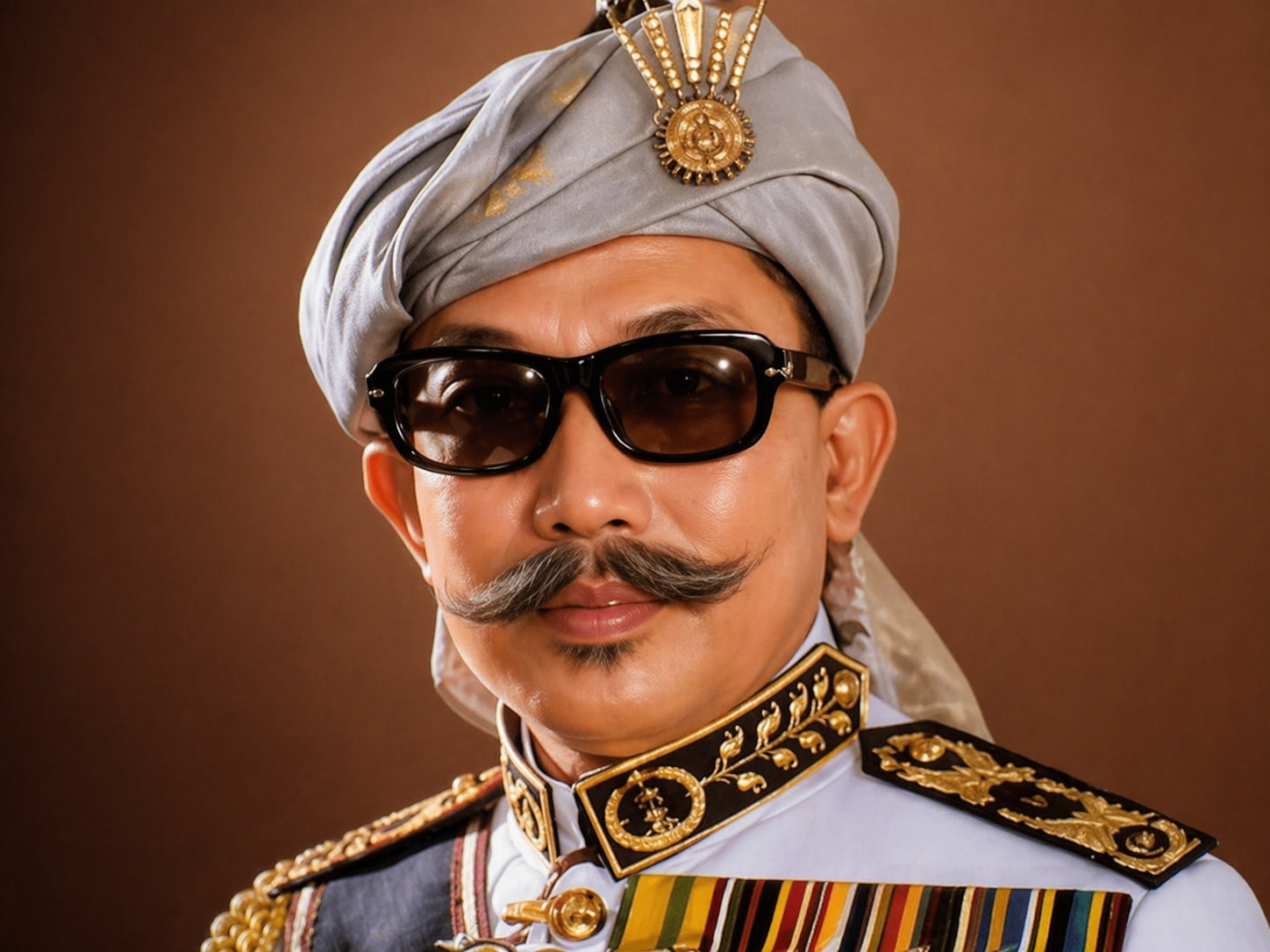
I grew up, like most Bruneians of my generation, surrounded by his presence without fully understanding it.
His face on our coins. His name on our mosque. The city we live in, renamed in his honour. The philosophy we were taught in school — MIB, Melayu Islam Beraja — so woven into the fabric of daily life that it felt less like a doctrine and more like the air itself. Only as I grew older did I begin to understand that none of this was inevitable. That someone had to decide all of it. That someone had to have the vision, the will, and the wisdom to look at a small, vulnerable, British-protected sultanate on the northern edge of Borneo and say: this will become something.
That someone was Sultan Omar Ali Saifuddien Sa’adul Khairi Waddien. The 28th Sultan of Brunei. The Architect of Modern Brunei. And the older I get, the more that title moves me.
He came to the throne not by long anticipation but by sudden loss. His brother died without an heir, and in June 1950, a prince who had once worked as a cadet officer in the Forestry Department inherited the weight of a nation. What strikes me about this — what has always struck me — is that he was ready. Not because power had been waiting for him, but because he had been quietly preparing himself for something, even if he did not know exactly what.
He was the first Brunei Sultan to receive a formal education abroad, at the Malay College Kuala Kangsar in Perak. He came home having seen the wider world, having understood how it worked — and having decided, clearly and deliberately, that Brunei would engage with that world on its own terms. Not as a colonial footnote. Not as a resource to be extracted. As a nation, with its own identity, its own faith, its own dignity.
That conviction ran through everything he did.
When I try to explain to people who are not Bruneian what Sultan Omar Ali built in his seventeen-year reign, I always struggle to convey the scale of it — because the Brunei he inherited and the Brunei he left behind are almost incomprehensible as the same place. He launched the first National Development Plan in 1953. Schools were built across the country. Roads were laid. The airport was developed. Oil and gas revenues — carefully stewarded — were turned into clinics, infrastructure, and opportunity. By the time he abdicated in 1967, infant mortality had halved. Life expectancy had doubled. A generation of Bruneian children grew up with access to education their parents had never had.
But the numbers, as always, do not capture it fully. What he was really building was something harder to measure: the belief, in the hearts of ordinary Bruneians, that their country had a future worth believing in.
That is not a small thing. That is, in fact, everything.
Then there is the mosque.
I have lived with that view my whole life — the golden dome catching the afternoon light over the lagoon, the minaret rising above the river, the whole structure reflected in the water as if the sky itself wanted a second look. I have taken that view for granted in the way you take for granted only the things that have always been there, the things so constant they become part of how you understand the world.
He designed it himself, in concept at least. And he chose the site deliberately — not the more convenient location that had been proposed, but the spot near the Brunei River, because he wanted it to be visible to the people of Kampong Ayer. The people on the water. His people.
Italian marble. Venetian glass mosaic. Belgian and Saudi carpets. English chandeliers. And yet it is, unmistakably, irreducibly, profoundly Bruneian. That was his gift — knowing how to bring the world’s finest craftsmanship to bear in service of something that never stopped being ours. The mosque is not a symbol of imported grandeur. It is a statement of who we are, rendered in stone and gold and light.
Every time I see it, I feel something I can only describe as gratitude.
But perhaps the deepest thing Sultan Omar Ali built was not a mosque, or a road, or a school — it was a philosophy.
Melayu Islam Beraja. The three pillars: Malay identity, Islamic faith, the institution of the monarchy. For those outside Brunei, it is sometimes reduced to a political slogan. For those of us who grew up here, it is something far more personal than that. It is the answer to the question every small nation must eventually face: who are we, and what do we stand for?
He answered that question with remarkable clarity. He said: we are a Malay nation. We are a Muslim nation. We are a monarchy with deep roots and a living tradition. And we do not need to apologise for any of it.
A nation that knows who it is can face the world from a position of dignity rather than anxiety. That, too, is not a small thing. That, too, is everything.
He abdicated in 1967, placing the throne in his son’s hands, and then did something that I find quietly extraordinary: he stayed. He remained present. He served as Brunei’s first Minister of Defence after independence in 1984. He was there to see the finish line he had spent decades laying the track toward. He passed away on 7 September 1986, having seen his nation arrive, at last, at sovereignty.
The city carries his name. The longest bridge in Southeast Asia carries his name. His face looks out from our first banknotes and our coins. These are the monuments we can point to.
But when I think of him, I do not think first of monuments. I think of the Brunei I was born into — educated, sovereign, grounded in faith, proud without arrogance, small in size and quietly sure of itself — and I know that none of it came from nowhere. Someone built the foundation. Someone did the work that made all the rest possible.
Whenever I stand somewhere in this country and feel, in whatever quiet moment, that sense of home — that particular, irreplaceable sense that this place is mine and I belong to it — I think of him.
Al-Fatihah.